Five years in the making, Pole to Pole With Will Smith follows Will across all seven continents, taking him from the icefields of Antarctica to the jungles of the Amazon, the mountains of the Himalayas, the deserts of Africa, the islands of the Pacific and the icebergs of the Arctic.
The 7×45-minute series is produced by Nutopia, Westbrook Studios and Protozoa for Nat Geo and Disney+. Here, Showrunner Tom Williams describes the challenge of creating a blockbuster adventure and natural world documentary series with the actor.

Will Smith and Nutopia previously partnered with National Geographic on One Strange Rock and Welcome to Earth, so for this show we wanted to build on that collaboration and go all out to make one of the most ambitious television series ever. To take an iconic movie star from Pole to Pole and bring the farthest reaches of our planet to life like never before using the most spectacular cinematography.
Will committed 100 filming days to the project and time and again threw himself into extraordinarily perilous situations which were far from his comfort zone. He tries to capture venomous tarantulas in the Amazon; he skis in a windchill of -35 F to the South Pole & scuba dives under the ice at the North Pole. No stunt men or green screens – this was an authentic adventure in the pursuit of world first science and a greater understanding of our planet and the extraordinary people who live here.
Creating the Series
The series was made over 5 years and for most of the crew – myself included- it was by far the greatest collaboration of our careers. Over 500 people from 35 different countries contributed. Film-makers alongside international scientists working in tandem with expedition guides and extraordinary indigenous and local people.
Our ambitions for the series were multi-layered from the get-go. We wanted to build on the jaw-dropping science and cinematography of One Strange Rock and Welcome To Earth but to take that ambition to showcase the most extreme places on the Earth. We also wanted to introduce a much stronger emotional element by making the series about people too.
In Antarctica, Will meets a Brazilian scientist who left Rio having never seen snow before, but who now lives in a portacabin hundreds of miles from anyone to measure atmospheric conditions whilst weathering temperatures around -35F. We were fascinated by what that life is like & what drives someone to make such a huge personal sacrifice to better predict the future of our planet. Whilst tracking anacondas in the Amazon, Will lives alongside a Waorani elder who grew up as an uncontacted boy- not knowing that the outside world even existed. He tells Will that he has partnered with the scientists on this expedition to try and protect his home. If they can get one scale of an anaconda, the scientific analysis could provide crucial evidence of oil pollution in this seemingly pristine and remote jungle.
The blend of cutting-edge science and humanity at the core of the show is what we hope makes it so rich and distinct for the audience. It was certainly a profound experience for Will. At the end of the project, he told me that ‘Traveling pole to pole has not only changed the way I see our planet, it’s changed the way I see myself” A quote we use in the final moments of the series.
The Epic and Intimate- Bringing the Extremes to Life
We went to many locations that no film crew had gone before- astoundingly spectacular environments in Papua New Guinea and Bhutan- but hugely challenging places to both get to & then film in. To bring these extremes to life for the audience we approached the filming with a simple mantra- the epic and the intimate.
For the epic, we created a bespoke camera package tailored to the unique environmental challenges on each shoot. Choosing from Arris Alexas, Sony Venices and Reds alongside gimbals like Shotover, and an array of traditional and FPV drones. We used every rig and mount imaginable – often bespoke designed & 3D printed- so that we could get the most cinematic shots whether we were abseiling 200ft down into a pitch black cave; paddling on an indigenous canoe in the Amazon, skiing across a frozen desert in Antarctica or crashing through hundreds of miles of sea ice to the North Pole.
The most important intimate POV was Will’s diary cam which he often used when no one else was around. We deliberately landed on a standard iPhone with a filmic dual view cam app because we wanted to create a relatable aesthetic in the extremes by mimicking how we all interact on our socials. But it needed a few upgrades – particularly at the Poles as the battery would die very quickly in super low temps. So our specialist camera team 3D printed a bespoke housing to keep the iPhone warm. Unfortunately it worked a little too well and the first time Will used it, the camera shut down because it got too hot!
Working with Will
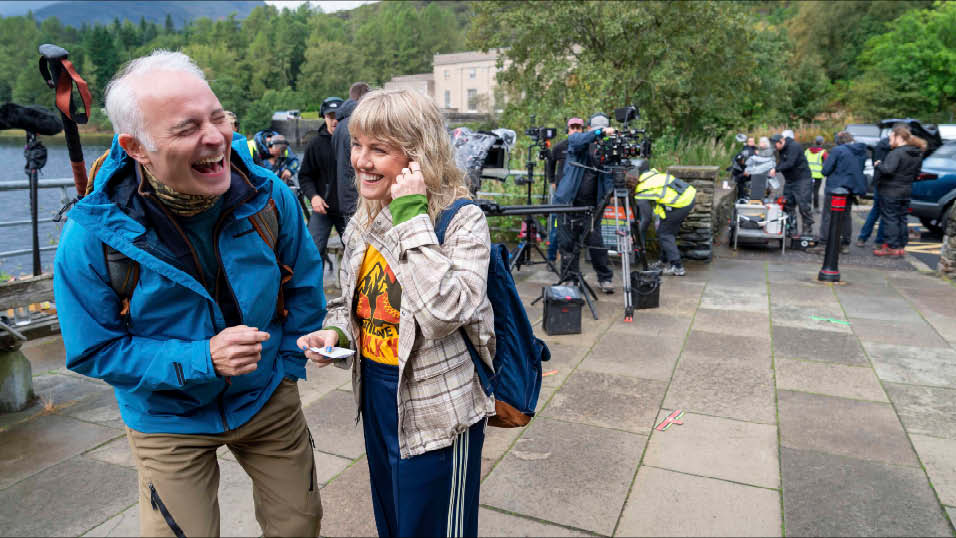
Will brought a huge amount of humour to the project- often laughing at himself like when exploring the cave of tarantulas- but he also approached the filming with a lot of curiosity, heart and vulnerability. I think that openness brought the best out of everyone- cast and crew- and allowed people to make a genuine connection across the series. So much so that just a few days ago, after a premiere and a week of back to back international press commitments, Will changed his plans to come to a crew screening and took the time to thank everyone personally.


Production company: Nutopia, Westbrook Studios and Protozoa
Commissioner: Bengt Anderson, Sean Johnson and Tom McDonald for National Geographic
Length: 7 x 45min
TX: January 14th, Disney +
Showrunner: Tom Williams
Directors: Tom Barbor-Might, Dionne Bromfield, Tom Williams
Executive producers: Will Smith, Terence Carter, Miguel Melendez, Peter Lovering, Jane Root, Darren Aronofsky, Ari Handel.
Executive in charge of production: Caroline McCool
Line producer: Becky Claridge
Post-house: Halo Post Production
Jon Creamer
Share this story