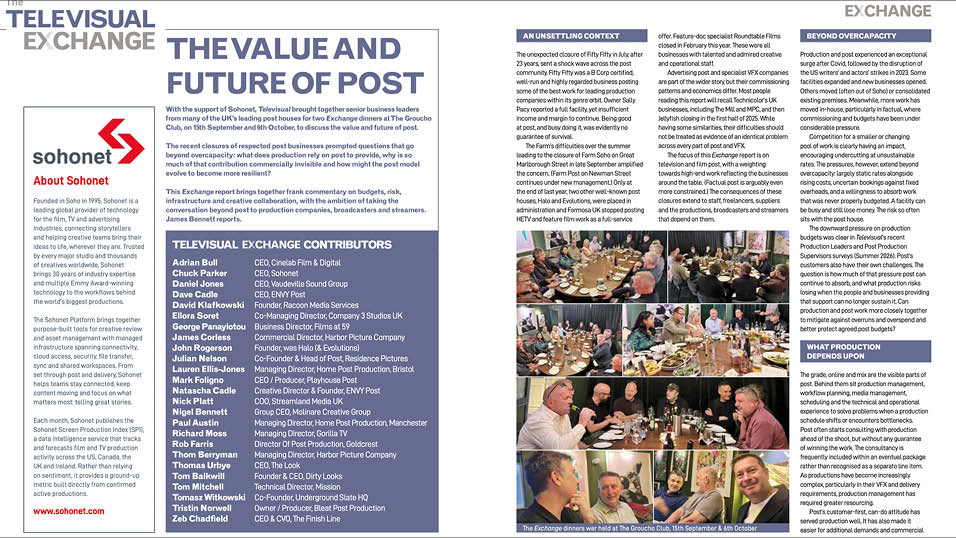
The Televisual Exchange report brings together the perspectives of 24 senior executives from many of the UK’s leading film and television post houses with executives from Sohonet to explore what role post plays now and how the business model might evolve over the coming years.
Read or download the report here
The recent closures of Farm Soho (not to be confused with Farm Post), Fifty Fifty, Roundtable Films, Halo and Evolutions have raised concerns about post’s financial resilience and sustainability across the whole UK production community. Fifty Fifty’s closure came as a surprise to many and sent ripples across the industry. Here was a post house that was busy finishing some of the best work from some of the highest profile indies within its genre orbit and yet it still failed to recover the cost of providing it.
At the same time, UK post is admired across the world for creative and operational excellence and the recent PACT Census reported that inward investment has reached record levels.
That tension sits at the heart of The Value and Future of Post, the latest Televisual Exchange report, supported by Sohonet.
The report draws on two private dinners held at The Groucho Club on 15th September and 6th October. The contributors were then all invited to send written contributions from which to compile the published report.
The report itself covers significant ground with frank commentary including:
- What does a post house actually do beyond the edit, grade and mix and how much of this this work is commercially visible? If on average only three or four in ten staff within a post house are ostensibly revenue generating, what does everyone else do?
- Has post’s can-do, customer-centric approach left it carrying too much risk within a world of shifting schedules, last-minute cancellations and unrealistic expectations when post is so often asked to make good on production overruns and overspends outside of its control? What would a more workable commercial arrangement look like? Should post budgets be protected and if so, how?
- When are on-premises workflows more and when less cost-effective than the proposed software-defined, cloud-first model? Does the distributed creative contributor model take account of in person collaboration and technical troubleshooting? Who takes responsibility for the workflow? And how are post’s own infrastructure and process costs considered within the budget?
- What might a future ‘hybrid’ post model look like? What does post own and what does it outsource or share? Who forms the core team of a future post house? Where should it be located? And how does the next generation learn their craft?
The report is intended to open a wider conversation with streamers, broadcasters and production executives on what they want from post and how the relationship could work better. All the contributors wanted to ensure the post model evolves in step with what is being asked of it while many asked for more reasonable commercial arrangements in a time of escalating staff, kit and real estate costs. The underlying belief that runs through the report is that post’s resilience is in the best interests of the wider UK production community and that UK post plays an important role in the UK’s overall global appeal and success.
Download the report here
Future Televisual Exchanges will explore what production wants from post, the post business model, VFX and independent production and budgeting.
Thank you to Chuck Parker and everyone at Sohonet for supporting the two Exchange dinners and this report.
And thank you to our post contributors for giving of their time and their thoughts:
Adrian Bull — Cinelab Film & Digital
Chuck Parker — Sohonet
Daniel Jones — Vaudeville Sound Group
Dave Cadle — ENVY Post
David Klafkowski — Racoon Media Services
Ellora Soret — Company 3 Studios UK
George Panayiotou — Films at 59
James Corless — Harbor Picture Company
John Rogerson — formerly Halo and Evolutions
Julian Nelson — Residence Pictures
Lauren Ellis-Jones — Home Post Production, Bristol
Mark Foligno — Playhouse Post
Natascha Cadle — ENVY Post
Nick Platt — Streamland Media UK
Nigel Bennett — Molinare Creative Group
Paul Austin — Home Post Production, Manchester
Richard Moss — Gorilla TV
Rob Farris — Goldcrest
Thom Berryman — Harbor Picture Company
Thomas Urbye — The Look
Tom Balkwill — Dirty Looks
Tom Mitchell — Mission
Tomasz Witkowski — Underground Slate HQ
Tristin Norwell — Bleat Post Production
Zeb Chadfield — The Finish Line
Download the report here and join the conversation
Jon Creamer
Share this story