Three-time BAFTA-winning director Philippa Lowthorpe has long been drawn to stories grounded in truth, stories that illuminate the quiet resilience of ordinary people thrust into extraordinary circumstances. So when screenwriter Stephen Butchard called her about a new project he described only as “top secret,” she agreed to join him before even knowing what it was.
I’ve always been drawn to stories rooted in truth, stories about ordinary people who find themselves in extraordinary circumstances, stories that reveal the quiet resilience that so often goes unseen. So when Stephen Butchard phoned me to say he had a “top-secret” project to discuss, I said yes before I even knew what it was. I trust Stephen implicitly. We developed a deep creative bond while making Five Daughters, discovering that we shared the same ethos: a commitment to human-centred storytelling that honours the lived experiences of real people.
When Stephen eventually told me the project was the story of Nazanin Zaghari-Ratcliffe and Richard Ratcliffe, my reaction was immediate: I have got to do this. Like everyone else, I had followed the headlines about Nazanin’s imprisonment and Richard’s extraordinary six-year campaign to bring her home, but the chance to step behind those headlines and tell their story through their own words felt urgent and necessary. The production team at Dancing Ledge Productions, led by Laurence Bowen and Chris Carey, then welcomed me onboard.
I’ve spent my career seeking out unheard voices, giving space to those too often overlooked. And although Richard became widely recognised during his campaign, the private reality of what he and Nazanin endured and the emotional cost remained largely invisible. In a world where truth is increasingly distorted, their experience feels frighteningly relevant.
The series draws from Nazanin and Richard’s forthcoming memoir, A Yard of Sky, and as a born researcher, I immersed myself in the early manuscript she and Richard had written. Nazanin’s words are so vivid, so gripping, they offered us a roadmap into the emotional landscape of their story, one that unfolds like something out of a Hollywood movie, but the shocking truth is that it really happened to them. Within her writing, I would find little details that I loved. For example when Nazanin is taken to the women’s ward – ‘Ward 5’, she’s invited to eat some eggs, some fried eggs. It was these little details that helped us make everything as real as possible so that you can almost smell it as well as see it. Even down to finding just the right fabrics that the women prisoners wore, with costume designer Justin Seymour.
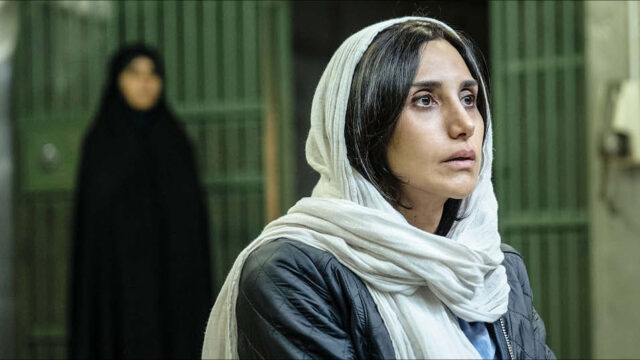
Authentic world-building was central to our production design. Production designer Stéphane Collonge immersed himself deeply in real-world references and, together with our brilliant Iranian advisor, crafted environments that feel truly lived-in, vivid, and honest. We were meticulous about every detail, from the architecture of the prison walls to the simplicity of Nazanin’s first meal. These small, intimate moments carry enormous weight, grounding the film in truth and bringing us closer to her lived experience.
Drama, unlike documentary, allowed us to enter spaces that cannot be filmed: the interrogation rooms, the moments of despair, the unspoken fears shared between a couple fighting to survive. It gives audiences not just the facts, but the emotional truth the chance to imagine what they would do, how they would cope, how they would hold on.
Authenticity became the lodestar of the production and guided every creative decision. As Stephen and I crafted the scripts, Richard and Nazanin read each draft, offering memories or gently correcting details. As a result Stephen’s scripts have that real gut punch of authenticity and truthfulness taking us into a world which none of us know much about, but which we can all relate to on a human level.
Working with cinematographer Ole Bratt-Birkeland, I wanted a visual style that blended realism with a taut, stripped-back drama. We were inspired by films like The Parallax View and All the President’s Men , works defined by economy of storytelling and an unembellished directness. No shot is spared, we were incredibly economical in the way we shot it, predominantly with a single camera, using limited coverage and strong and considered compositions. On the surface, it appears straightforward, but this direct gaze helps create a powerful subjective point of view . We also used handheld or Steadicam, punctuating moments of confusion or shock to mirror the jarring shifts in Nazanin’s world, and also to create the more lyrical memories of their life as a couple. It’s about the subjective point of view of the characters, everything is told from Nazanin’s point of view, or Richard’s point of view. Everything is with them at any one time and we stuck absolutely to that rule.
I introduced visual “family albums” shot on Super 16 film lenses to provide the audience with memories of Richard and Nazanin’s early relationship, their wedding, their daughter, their family gatherings. These moments build their emotional landscape and offer glimpses of what their life was like before she was taken hostage and what they are fighting for. As the story progresses, the footage subtly degrades, mirroring Nazanin’s growing distance from her former life.
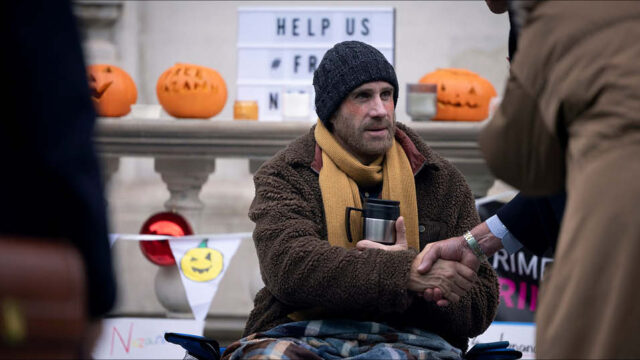
Authenticity extended to the casting process. Working with Robert Stern, we looked for actors capable of deep naturalism, able to give performances that felt lived rather than performed. Joseph Fiennes and Narges Rashidi immersed themselves in Richard and Nazanin’s inner worlds with extraordinary dedication. They approached their roles with immense seriousness, doing extensive personal preparation even before rehearsals began.
Although I had a very clear creative vision, it was vital to give the actors the space to inhabit their characters freely. Ole Bratt Birkland’s lighting design supported this, allowing them to move naturally within the frame rather than being fixed to precise marks. Filming this way kept everyone alert and provided a vivid, lived energy to each scene. Robert assembled a cast who thrived in that environment, including our remarkable Iranian actors, among them the interrogators, played by Armin Karima and Zanyar Mohammadi, and Bijan Daneshmand and Behi Djanati Atai who delivered truly compelling performances as Nazanin’s parents. The relevant sections of Stephen’s scripts were translated into Farsi by Narguess Farzad. We actually ended up working with trilingual scripts when we were filming – Farsi, Finglish for our Iranian actors who speak but do not read Farsi, and English. Farsi is such a beautiful and poetic language.
I like to stay physically close to my actors during takes, becoming their first audience and maintaining what I call an “umbilical connection.” Ole Bratt Birkland mirrored this approach with his sensitive camerawork, creating a safe, intimate space for the actors to explore vulnerability, fear, and resilience with honesty.
Sound was integral from the outset. Our brilliant Editor Úna Ní Dhonghaíle, with whom I’ve collaborated on The Crown, Misbehaviour and Three Girls, began layering sound into the cut from the earliest stages, shaping the subjective worlds of our characters. Composer Dickon Hinchliffe then created a score blending British and Iranian musical textures. Later, Iranian musicians added santur and vocal layers, enriching the musical palette. The final soundscape feels both grounded and otherworldly echoing the dislocation at the heart of Nazanin’s experience.
Prisoner 951 is a story of two ordinary people bound together through unimaginable circumstances. It is a story of endurance, hope and the courage to stay human when the world threatens to unravel you. At its core it is a love story and I felt a profound responsibility to tell Richard and Nazanin’s story with honesty and care. And I hope that, in watching it, audiences will feel what was at stake, and what it means to fight for someone you love.




Prisoner 951 became available in full on BBC iPlayer from 6am on Sunday 23 November, and airs on BBC One from 9pm last night.
Jon Creamer
Share this story