It’s twenty years since the last major screen adaptation of Pride and Prejudice. At the start of December, Netflix will launch its six-part series that aims to bring the Jane Austen story to a new audience.
The series, which stars Jack Lowden as awkward hero Mr Darcy and Emma Corrin as the heroine Elizabeth, is produced by Lookout Point. “It came out of a conversation with Netflix and thinking about classics and how we can approach them now,” says executive producer Laura Lankester.
Dolly Alderton has written the screenplay. While Alderton is known for her contemporary drama and Netflix for its very modern approaches to period pieces, this time it’s all about tradition. “It feels like a classic adaptation,” says Lankester.
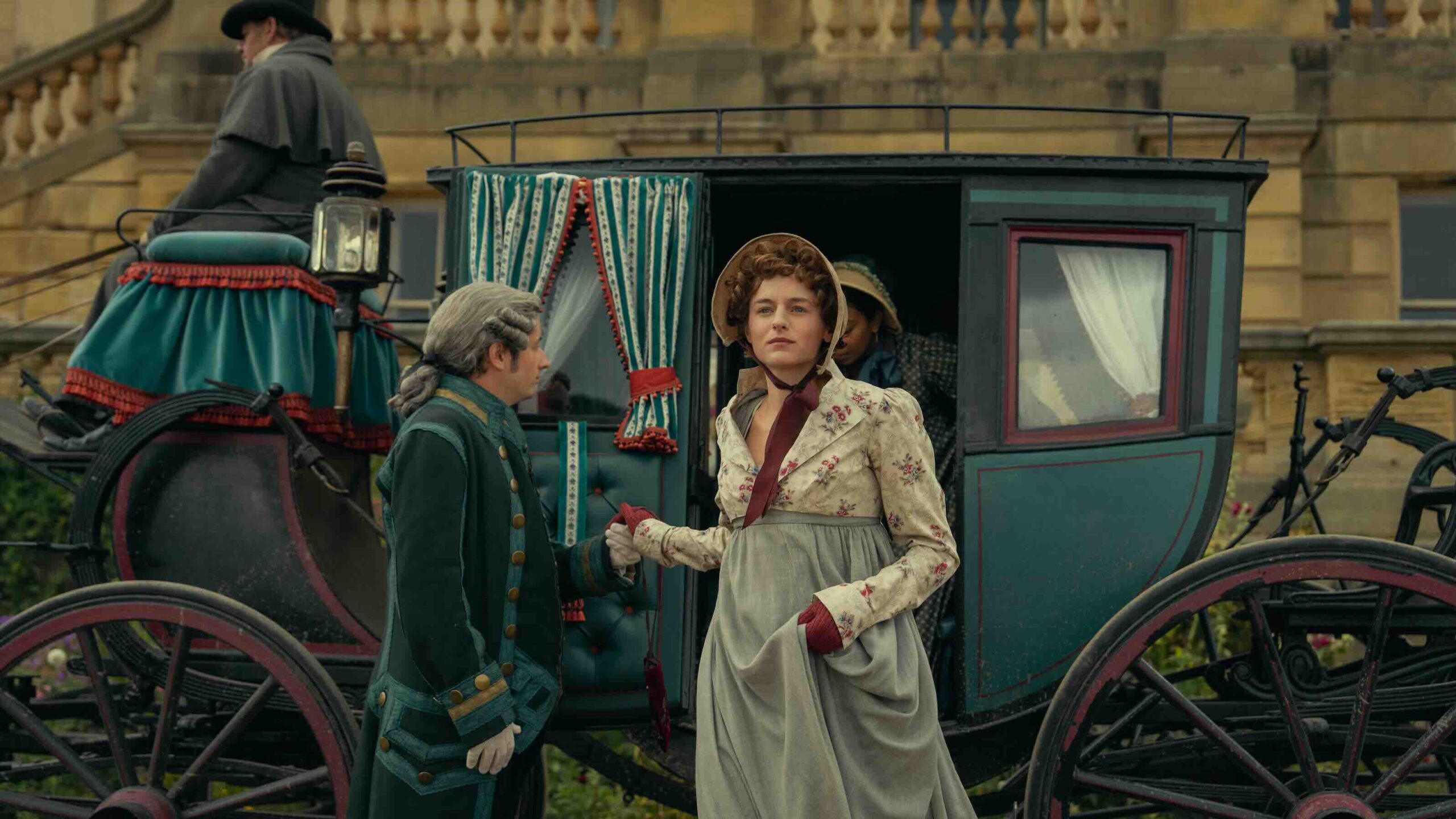
The approach – from lighting, costume and production design, through to the edit and the grade – has been to represent the Regency era. But contemporary life has crept in, admits Lankester. “We do it a little bit unconsciously. It’s going to be the 2025 version.”
Euros Lyn (Heartstopper, Happy Valley) directed. “He has such an eye for what we want it to look like,” says Lankester.
All six episodes were shot on location. “Studio builds would be too expensive” says producer Lisa Osbourne. Golden Parsonage in Hertfordshire was Longbourn, the Bennett’s family home. “We’ve been here so much, it has felt that this is our studio.” Televisual was invited to the shoot on the last day of filming in Autumn 2025.
Other locations included Harewood House as Pemberley, Darcy’s family seat and Hatfield House for the the stately home belonging to Catherine de Burgh, Rosings. “Everybody’s property is a signifier of their class,” says Osbourne. “Longbourn has to be less wealthy than Netherfield [rented by Darcy’s friend Bingley], which is less wealthy than Pemberley, which is less wealthy than Rosings.”
Golden Parsonage has been lived in by the same family for generations. “It is actually a family home,” says Osbourne. “And when we saw it first, it felt warm and inviting and friendly.” Which, along with the natural world, are the key ingredients to the look and feel of the series.
Added to which, says Production Designer Richard Bullock, while being allowed to ‘borrow’ furniture and artwork from the owners, “we were able to completely redecorate the entire place.” Inside and out.
“When we first came here, it was very much just a big square Georgian sort of block,” says Bullock. “We added finials along the top of the building. We built the wall around the outside of the turning circle out front and we added greenery.” They also painted the exterior and added a canopy over the porch. “We softened the lines. ..brought the house it into the landscape a bit more.”
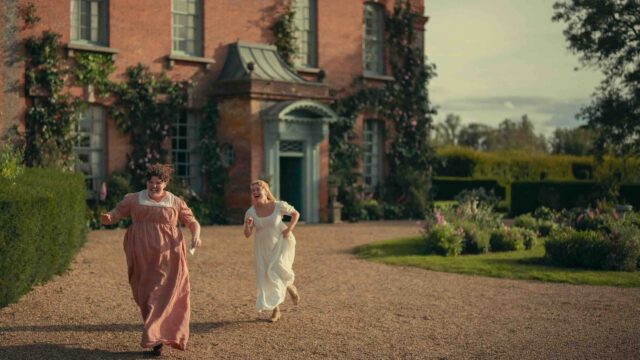
“Longbourn is at the heart of the story, so it’s got to do a lot of visual storytelling. In our version of Pride and Prejudice, Mrs. Bennet is somebody with quite a bit of style and is trying to present them as a successful family.”
“The drawing room would be the showpiece. We tried to make that look stylish and modern in its period. In the hallway we’ve gone for period wallpaper in colours that are right for the period, but are something a little bit more striking than your usual Regency palette.” Longbourn is predominantly blue. “We went for this aquatic blue, because it feels suitable to the family and the location, and it’s not something that we’re seeing in other places, so it should feel nice and distinct.”
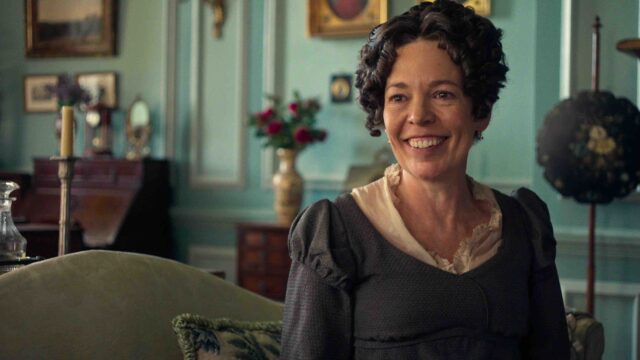
The budget didn’t run to the Regency luxury of silk for the wallpaper, but “we put a glaze on it that ages it and gives it a bit of shine. It actually ends up looking better than the silk version.”
Lyn, Bullock and all of the production team were looking for warmth and lightness to reflect the comedy and romance, as well as keeping nature at the forefront.
“We were trying to build the link with nature and with the exterior and with the seasons,” says Bullock. “We go through a year in the story, but we can’t film it in season order.” Televisual visited Golden Parsonage in November. “The guys are out there turning it into winter. We’ve got to have it back to summer again on Monday.” Artificial flowers, alongside real plants, helped with the transformation.
For references, “we looked at prints and paintings and Regency houses that haven’t been redecorated,” says Bullock. “There’s a cartoonist called Robinson who was active at this time. He’s a great visual source. And then the other thing is films like Barry Lyndon which has been quite an influence on us.”
Various carriages were hired reproductions from Devil’s Horsemen. “Getting working tuneable pianos was tricky,” adds Bullock.
And when the filming wrapped, what was the future of the meticulously decorated Longbourn set?
Restored as found, explains Bullock. “The owners can choose whether they want to keep anything, but we planned to strip everything out.”
Pippa Considine
Share this story