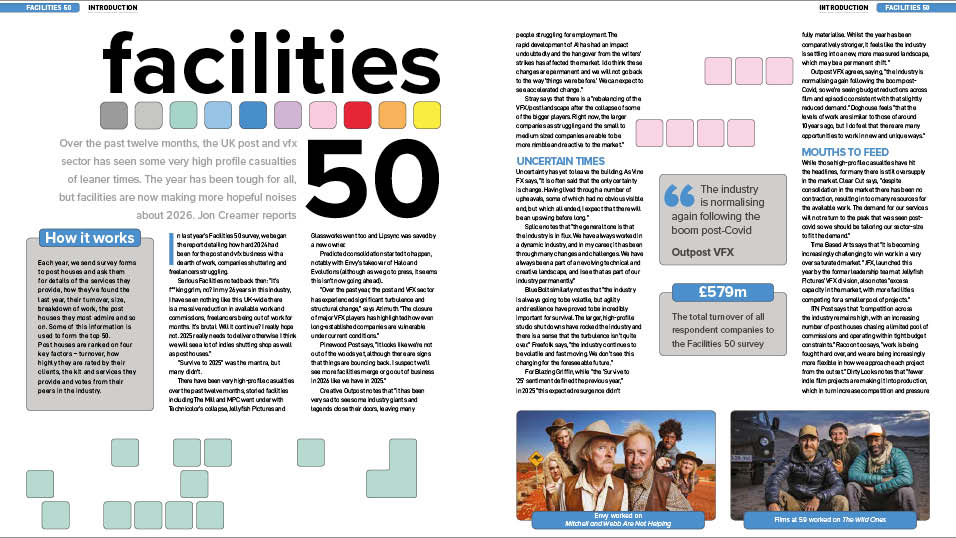
Over the past twelve months, the UK post and vfx sector has seen some very high profile casualties of leaner times. The year has been tough for all, but facilities are now making more hopeful noises about 2026. Jon Creamer reports
In last year’s Facilities 50 survey, we began the report detailing how hard 2024 had been for the post and vfx business with a dearth of work, companies shuttering and freelancers struggling.
Serious Facilities noted back then: “It’s f**king grim, no? In my 26 years in this industry, I have seen nothing like this. UK-wide there is a massive reduction in available work and commissions, freelancers being out of work for months. It’s brutal. Will it continue? I really hope not. 2025 really needs to deliver otherwise I think we will see a lot of indies shutting shop as well as post houses.”
“Survive to 2025” was the mantra, but many didn’t.
There have been very high-profile casualties over the past twelve months, storied facilities including The Mill and MPC went under with Technicolor’s collapse, Jellyfish Pictures and Glassworks went too and Lipsync was saved by a new owner.
Predicted consolidation started to happen, notably with Envy’s takeover of Halo and Evolutions (although as we go to press, it seems this isn’t now going ahead)..
“Over the past year, the post and VFX sector has experienced significant turbulence and structural change,” says Azimuth. “The closure of major VFX players has highlighted how even long-established companies are vulnerable under current conditions.”
Pinewood Post says, “It looks like we’re not out of the woods yet, although there are signs that things are bouncing back. I suspect we’ll see more facilities merge or go out of business in 2026 like we have in 2025.”
Creative Outpost notes that “it has been very sad to see some industry giants and legends close their doors, leaving many people struggling for employment. The rapid development of AI has had an impact undoubtedly and the hangover from the writers’ strikes has affected the market. I do think these changes are permanent and we will not go back to the way ‘things were before.’ We can expect to see accelerated change.”
Stray says that there is a “rebalancing of the VFX/post landscape after the collapse of some of the bigger players. Right now, the larger companies as struggling and the small to medium sized companies are able to be more nimble and reactive to the market.”
UNCERTAIN TIMES
Uncertainty has yet to leave the building. As Vine FX says, “It is often said that the only certainty is change. Having lived through a number of upheavals, some of which had no obvious visible end, but which all ended, I expect that there will be an upswing before long.”
Splice notes that “the general tone is that the industry is in flux. We have always worked in a dynamic industry, and in my career, it has been through many changes and challenges. We have always been a part of an evolving technical and creative landscape, and I see that as part of our industry permanently.”
BlueBolt similarly notes that “the industry is always going to be volatile, but agility and resilience have proved to be incredibly important for survival. The larger, high-profile studio shut downs have rocked the industry and there is a sense that the turbulence isn’t quite over.” Freefolk says, “the industry continues to be volatile and fast moving. We don’t see this changing for the foreseeable future.”
For Blazing Griffin, while “the ‘Survive to ’25’ sentiment defined the previous year,” in 2025 “this expected resurgence didn’t fully materialise. Whilst the year has been comparatively stronger, it feels like the industry is settling into a new, more measured landscape, which may be a permanent shift.”
Outpost VFX agrees, saying, “the industry is normalising again following the boom post-Covid, so we’re seeing budget reductions across film and episodic consistent with that slightly reduced demand.” Doghouse feels “that the levels of work are similar to those of around 10 years ago, but I do feel that there are many opportunities to work in new and unique ways.”
MOUTHS TO FEED
While those high-profile casualties have hit the headlines, for many there is still oversupply in the market. Clear Cut says, “despite consolidation in the market there has been no contraction, resulting in too many resources for the available work. The demand for our services will not return to the peak that was seen post-covid so we should be tailoring our sector-size to fit the demand.”
Time Based Arts says that “it is becoming increasingly challenging to win work in a very over saturated market.” JFX, launched this year by the former leadership team at Jellyfish Pictures’ VFX division, also notes “excess capacity in the market, with more facilities competing for a smaller pool of projects.”
ITN Post says that “competition across the industry remains high, with an increasing number of post houses chasing a limited pool of commissions and operating within tight budget constraints.” Racoon too says, “work is being fought hard over, and we are being increasingly more flexible in how we approach each project from the outset.” Dirty Looks notes that “fewer indie film projects are making it into production, which in turn increase competition and pressure in an already-saturated and over-supplied market of post-production suppliers in London.”
And there are still “numerous smaller boutiques seeking work, which is driving competitive pricing pressures downward,” says Framestore. Dock10 also sees “increased competition for work with newer post facilities locally and nationally.”……….
Jon Creamer
Share this story