BAFTA- and EMMY-winning natural history specialists Humble Bee Films have become the first production company to collaborate with the University of Bristol’s MyWorld programme at the Sheds on a virtual production sequence for a natural history series. The sequence — part of their new Sky Nature and Blue Ant Media series exploring the Moon’s influence on animal behaviour — set out to make the invisible visible.
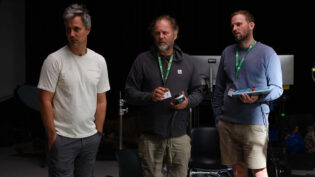
Series Producer Dominic Weston and Producer-Director Robert Wilcox reveal the creative ambitions, scientific discoveries and technical challenges behind the production.
Illuminating The Unseen
Dominic Weston: At Humble Bee Films we’re always searching for new ways to tell natural history stories—often by weaving scientific breakthroughs into immersive, character-led narratives. Attenborough’s Life in Colour and Secret World of Sound with David Attenborough both required us to visualise natural phenomena humans cannot see or hear. With MOON: Nature’s Secret Force, the creative challenge was similar, but on a lunar scale.
The Moon is familiar yet strangely unknowable. Its pull on wildlife has inspired myth and speculation for centuries. What we found while making the series was far more surprising… and far more difficult to film.
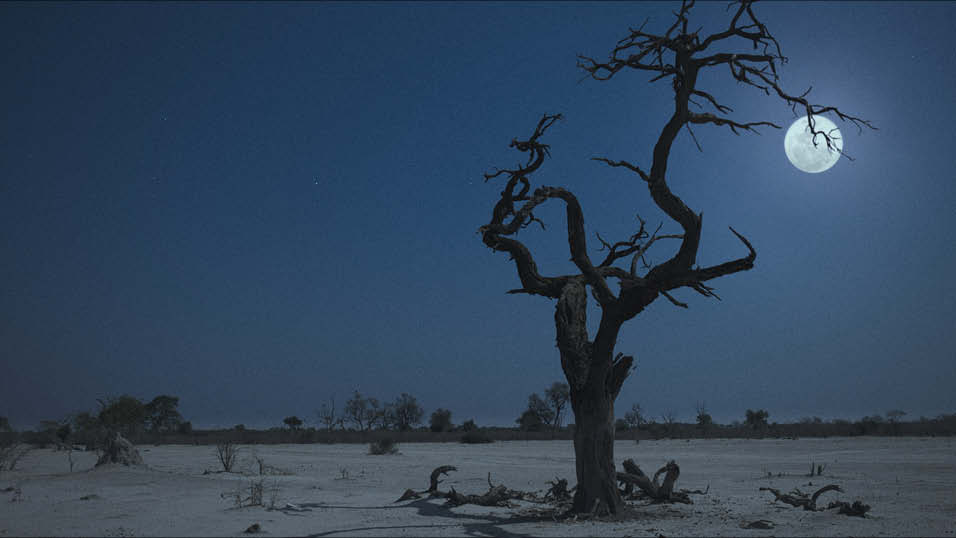
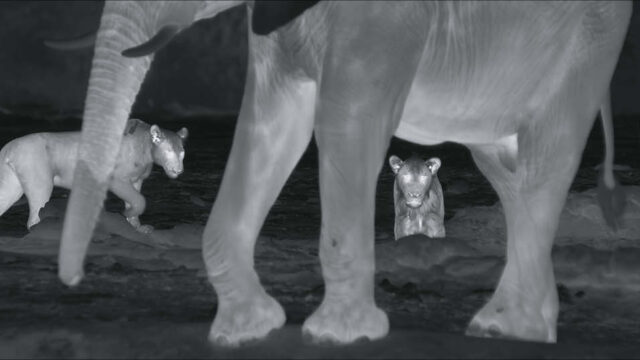
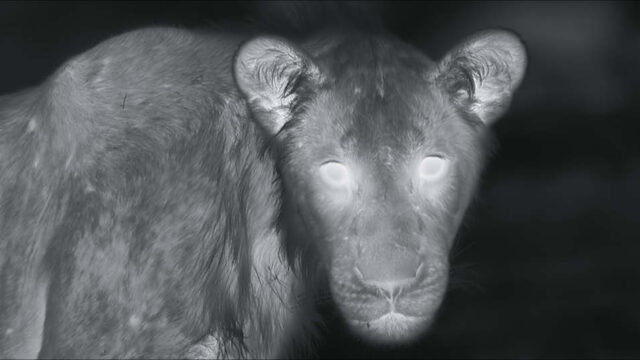
A full moon can look so bright in the dark night sky, but for filming it is a real challenge, as there is just not enough light to capture detail. But technology is advancing so fast, and our shoots coincided with the release of a highly powerful new camera, the Canon ML-105. Barely the size of a Rubik’s cube, with a huge 1000mm CN20 hanging off the end, it allowed us to capture in colour the shifting dynamics between elephants and lions at an African waterhole after sunset, in the opening episode, Dining By Moonlight.
On a new moon the savannah reflects a lot of light, and the ML-105 can clearly show how the elephants can see their adversaries and hold their own, but on a new moon there is no light at all, and we had to switch to a monochrome SELEX thermal camera, as the Lions’ own night vision gave them the upper hand. But changing light levels across the month are only one way the Moon influences animals’ lives.
A Hidden Lunar World
Rob Wilcox: For the navigation episode, Guided By The Moon, I immersed myself in planetary science—delving into reflected light, geomagnetism, gravity, tides and even plate tectonics. New research from teams in Hawaii, Alaska and New Zealand revealed extraordinary findings about humpback whales: the sacrifices mothers make, and how the animals read Earth’s magnetic field along with subtle changes in gravity. These invisible forces permeate our planet.
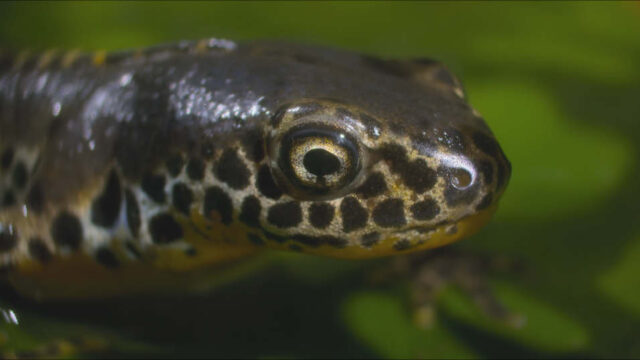
Wildlife filmmaking sometimes demands that the wildest worlds are built indoors—especially when capturing the “unfilmable”: in our case, the effect of Earth’s electromagnetic field on a finger-sized Alpine newt navigating from deep forest to its breeding pond.
For delicate species like newts, controlled studio environments are essential—not just for animal welfare, but for precision storytelling. Indoors, light, weather and motion become cinematic tools. The challenge is ensuring the world feels authentic to the animal and the audience.
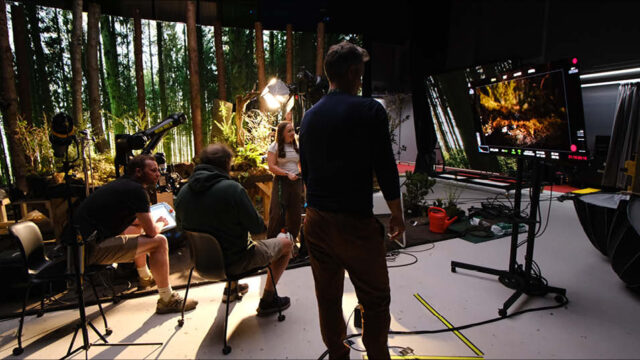
This ambition required cutting-edge imaging and a bold creative approach. In collaboration with MyWorld, Bristol University’s new creative technology research hub, we used a full-scale Virtual Production (VP) volume to attempt a world-first in natural history filmmaking.
Pushing The Technological Frontier
Mitch Turnbull, a Senior Research Associate in immersive productions at the University of Bristol reflects on the significance of the collaboration with Humble Bee Films:
“Natural history is hard to produce. At the very heart of these productions is the technology that is used to capture extraordinary imagery of animal behaviour. To make those sequences really immersive and compelling, the technology envelope needs to be continually pushed.
Production companies working on ever tighter budgets often don’t have a chance to experiment, so working alongside university researchers, using cutting-edge technologies and facilities, such as these, allows industry to push those envelopes, experiment and iterate, and break new ground in how these amazing sequences are captured and then delivered to audiences in a compelling way.”
Building A Forest Indoors
Robert Wilcox: Originally developed for feature films and commercials, Virtual Production merges live-action footage with computer-generated backgrounds rendered in real time. For me, it was the perfect medium to reimagine the hidden world of an Alpine newt — to create something both visually stunning and scientifically grounded.
I set out with two goals: to craft a cinematic, character-led sequence with a strong narrative, and to test the potential of this technology for future wildlife productions. The world had to be authentic — a forest that felt alive — but it also had to give us creative point of difference when compared to more conventional studio set ups used when filming macro.
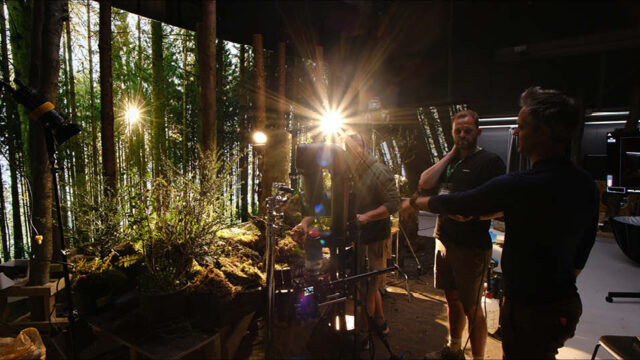
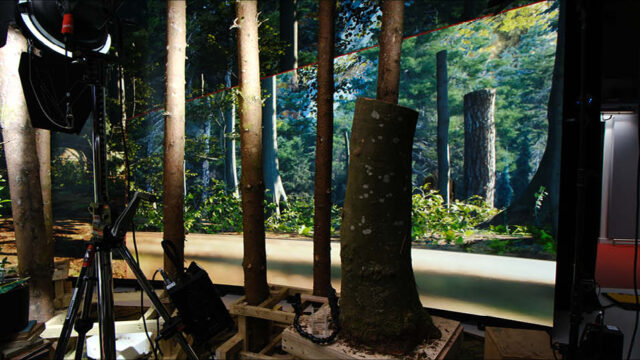
The sheer scale of the LED screen (9 meters wide by 4 meters high) allowed for sweeping camera moves and intimate low-angle shots. Unlike traditional blue-screen setups, where reflections, light bleed, and compositing can limit creativity, this digital forest could be lit, animated, and filmed directly in-camera. We could simulate a spring storm rolling through, or watch the sun set over a mossy log — all without ever stepping outside.
Working alongside storyboard artists, set builders, VFX specialists, lighting designers, VP engineers, and camera operators and even a snake wrangler was a first for me. It was also a first for everyone involved. None of us had attempted a natural history sequence on this scale using Virtual Production before.
To build our forest, we combined LiDAR and vision scans of real trees and foliage gathered from nearby woodlands with high-fidelity digital assets from specialized libraries. The forest was populated with native European species, layered to give a sense of true depth — both three-dimensional and 2.5D. Using Unreal Engine, we could manipulate time and space at will: shifting light from dawn to dusk, changing the weather, or even moving individual trees with a click of a mouse.
Physical elements like moss, stones, and logs grounded the digital forest in reality. The seamless blend of tangible textures and dynamic virtual depth meant we could move faster than in traditional setups — changing lighting or scenery with ease.
Ultimately, Virtual Production offered not just the ability to capture one of the Moon’s invisible influences, but also creative freedom and, I feel with greater realism. The goal was never for the technology to be noticed. Instead, it should simply feel natural, a believable world for a newt to explore.
When you see the final sequence, I hope you won’t be thinking about the LED walls, the software, or the dozens of people behind the cameras. I hope you’ll be right there with the Alpine newt as he moves through the lush forest in search of the pond that calls him home.
Production company: Humble Bee Films
Commissioners: Kathryn Taylor at SKY & Katie Murdock at Blue Ant Media/Love Nature
Length: 3 x 55min
TX: November 30th, SKY and NOW TV, will come to LOVE NATURE globally soon
Narrator: Tilda Swinton
Composer: Sophy Purnell
Producer-Directors: Eloisa Noble, Nalini Crack, Robert Wilcox
Series Producer: Dominic Weston
Executive Producers: Stephen Dunleavy, Charlotte Crosse
Post-house: Films at 59
https://www.humblebeefilms.com/ https://www.myworld-creates.com/
Jon Creamer
Share this story